Most drivers replace their car battery reactively. The battery dies. The car won’t start. They call a mechanic in a panic and pay whatever it costs to get moving again.
The smarter approach is knowing what the average lifespan actually looks like. What is the average lifespan of a car battery? How does Queensland’s climate affect that number? And what do professional auto technicians check to know when it’s actually time?
This guide gives a clear, mechanic-verified answer to all of it.
Here’s what you’ll learn:
- What the average car battery lifespan is nationally and in Queensland
- The specific factors that shorten battery life in Brisbane’s climate
- When to replace and why age alone is a valid reason
- How to test whether a battery still has usable life remaining
What Is the Average Lifespan of a Car Battery?
The average car battery lasts 3 to 5 years nationally. Most passenger vehicles in Australia need a replacement somewhere in that window, depending on climate, driving habits, and battery quality.
That time frame is not a firm deadline. Consider it a risk window.
There is no guarantee that a battery will fail after three years. However, now is when failure is more probable than before. Even after five years, a battery has defied expectations. The majority of them haven’t been able to maintain even a moderate level of function.
At the very top of the spectrum are AGM units and premium batteries. On the lower end of the spectrum are budget lead-acid units found in vehicles that conduct short journeys during hot weather. None of those factors, including the passing of time, can tell you how many miles an automobile battery will survive under your particular conditions.
Battery testing and replacement decisions should be based on actual capacity data, not just age. A load test at year 3 tells you where the battery actually sits.
Knowing what replacement costs before the test helps too. This guide on how much car battery replacement costs in Brisbane gives a clear breakdown so there are no surprises when the result comes back.
What Shortens a Car Battery’s Lifespan in Queensland?
One major element that reduces the longevity of car battery lifespan in Brisbane is the persistent heat of Queensland. Heat speeds up the internal chemical breakdown that determines a battery’s capacity, therefore batteries in warmer areas degrade at a higher pace than the national average.
What goes on within the battery is as follows.
The electrolyte evaporates more quickly in a hot battery. Coverage of the lead plates decreases as the fluid level decreases. The exposed plates are more prone to corrosion. Corrosion never goes away. It is irreversible. The battery’s ability to retain charge is negatively impacted once plate damage occurs, leading to accelerated degradation going forward. This happens more quickly and with more force than most drivers anticipate in a Queensland summer.
The second component is brief excursions. There isn’t enough time for the alternator to completely recharge the battery from the startup pull if the time is less than 15 minutes. The battery will remain partially charged for the majority of its lifespan if you do that consistently. That’s far worse than a whole cycle of discharging and charging.
Electrical load is the third component. These days, most people drive quickly. Climate control, rearview cameras, audio/video systems, and technology to aid drivers. Every single one of them drains the battery. This is particularly true in traffic jams because the engine idling reduces alternator output.
Car battery lifespan Brisbane is shorter than the national average because of the heat. A vehicle diagnostics service check from year 3 onwards catches degradation before it becomes a breakdown. Local auto repair Brisbane mechanics run load tests as standard, not as an optional add-on.
For a full breakdown of how Brisbane’s climate affects battery replacement decisions, the car battery replacement guide for Brisbane drivers covers every factor in detail.
When Is the Right Time to Replace a Car Battery?
Proactively replacing a car battery every three to four years is the correct time in Queensland. Not when it doesn’t work. A battery that dies unexpectedly and without warning is far more expensive than one that is replaced at the recommended intervals. The cost of towing, emergency calls, and wasted time can quickly build up.
Here’s a straightforward decision framework.
Age: In Queensland, it is safe to replace a battery that is four years old or older, regardless of symptoms. After this time, the likelihood of an unexpected breakdown grows substantially.
Load test result: When the battery’s State of Health drops below 70% on a load tester, it indicates that it is time to replace it. It may be starting the automobile now, but that won’t last forever. A load test reading, in addition to a visual inspection, is an essential part of any dependable vehicle repair.
Symptoms: Slow cranking, dim headlights at idle, erratic electrics, a battery warning light, or more than one jump start in a short period all point toward replacement. Any two of these together mean act now.
When to replace car battery is the question most drivers ask too late. The answer is always before any of the above becomes an emergency.
To book a battery test rather than waiting for the battery to decide the timing for you, this page on book a battery test in Brisbane covers service coverage and same-day options.
How Do You Test Whether a Battery Still Has Usable Life?
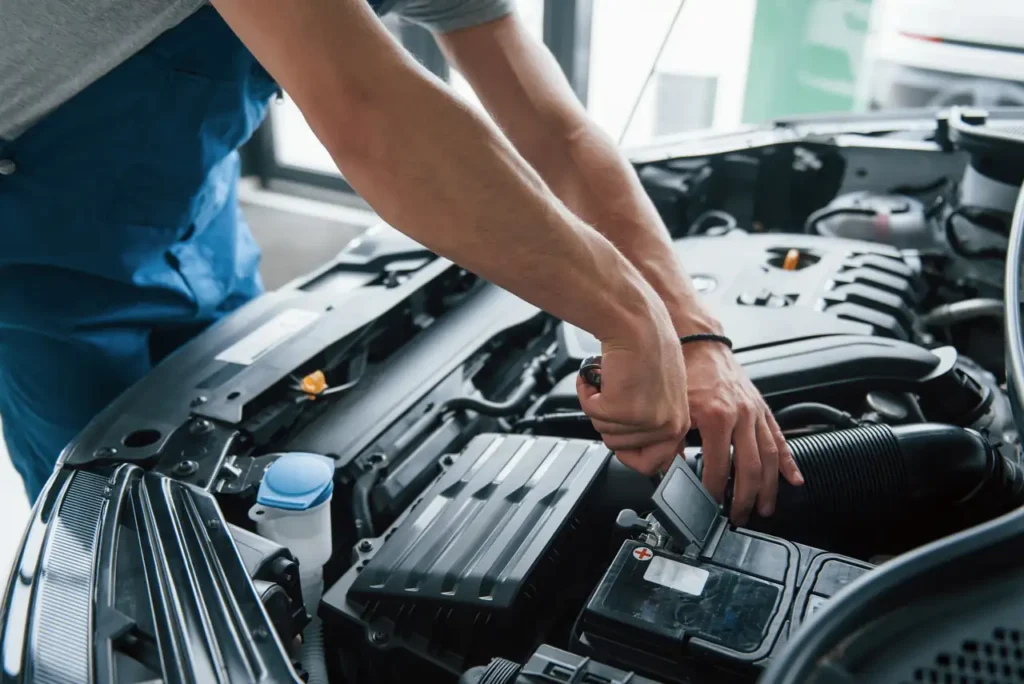
A load test is the only foolproof method for determining whether an automobile battery is still serviceable. Instead of using voltage, it uses percentages to measure the State of Health. This provides an accurate depiction of the available capacity.
For this reason, voltage is insufficient on its own. On a multimeter, a battery that is resting at 12.6 volts appears to be in good health. However, the behaviour under load cannot be inferred from the resting voltage. Even with a 50% state of health battery, the starter motor pulls hundreds of amps, which can be too much for the battery to handle during engine starting. No problems were detected by the multimeter. The vehicle remained silent.
The battery’s ability to maintain voltage under a regulated current draw is evaluated using a load tester. If the battery’s health indicator drops below 70%, it won’t be able to consistently provide the power your car needs. This test is routinely performed by professional vehicle mechanics since it provides the only accurate result.
The duration of the test is around five minutes. It suggests either returning in a year or replacing right now. There is no estimation required.
If you want to understand what the symptoms of a failing battery look like before it reaches the test stage, this guide on warning signs your battery is about to fail explains each one clearly.
What is the Average Lifespan of a Car Battery in Queensland Specifically?
On average, a car battery in Queensland will last between three and four years. The national average is one full year longer. Cars whose batteries are left in the sun all day or that get driven for short distances often will deplete their power reserves quickest.
The practical takeaway is simple.
Check at year 3. Don’t wait for symptoms. Get a load test. If the result comes back above 70% State of Health, the battery has life left. Check again in 6 to 12 months. If it comes back below 70%, replace it now on your terms, not after it leaves you stranded.
After four years, unless otherwise indicated by a load test, replace. It would be irresponsible to leave it to chance in Queensland’s climate after four years due to the high probability of unexpected failure.
For a driver in Brisbane who does short commutes and school runs during the summer, how long does a battery typically last? More like three years than four. Make preparations appropriately.
A mechanic near me search for battery testing is the fastest way to get a reliable answer. The test is quick, the result is clear, and the decision makes itself.
Final Thoughts
The average car battery lifespan in Queensland is shorter than most drivers realise. And the cost of a proactive replacement is always less than an emergency callout. Knowing when to act is the simplest form of vehicle maintenance.
For fast battery testing and replacement across Brisbane, Car One Automotive gives you a straight answer and a battery that works.
Frequently Asked Questions
What is the average lifespan of a car battery?
Three to five years nationally. The range reflects climate, driving habits, and battery quality. Premium batteries and AGM units last longer. Budget batteries in hot climates doing short trips sit at the lower end.
How long does a car battery last in Queensland?
Three to four years on average. Queensland’s sustained heat shortens lifespan compared to cooler states. Batteries in vehicles parked in direct sun or used mainly for short trips often reach the lower end of that range first.
What shortens a car battery’s lifespan?
Heat is the biggest factor, followed by frequent short trips under 15 minutes and high electrical load. All three reduce how well a battery holds charge over time. Queensland drivers face all three regularly.
How do you know when to replace a car battery?
Replace proactively at 3 to 4 years in Queensland. A load test reading below 70% State of Health confirms it’s time even if the battery is still starting the car. Don’t wait for symptoms.
Can you test a car battery before it fails?
Yes. A load test measures State of Health as a percentage and is far more reliable than a voltage check alone. Any battery past year 3 in Queensland should be load tested, not just visually inspected.