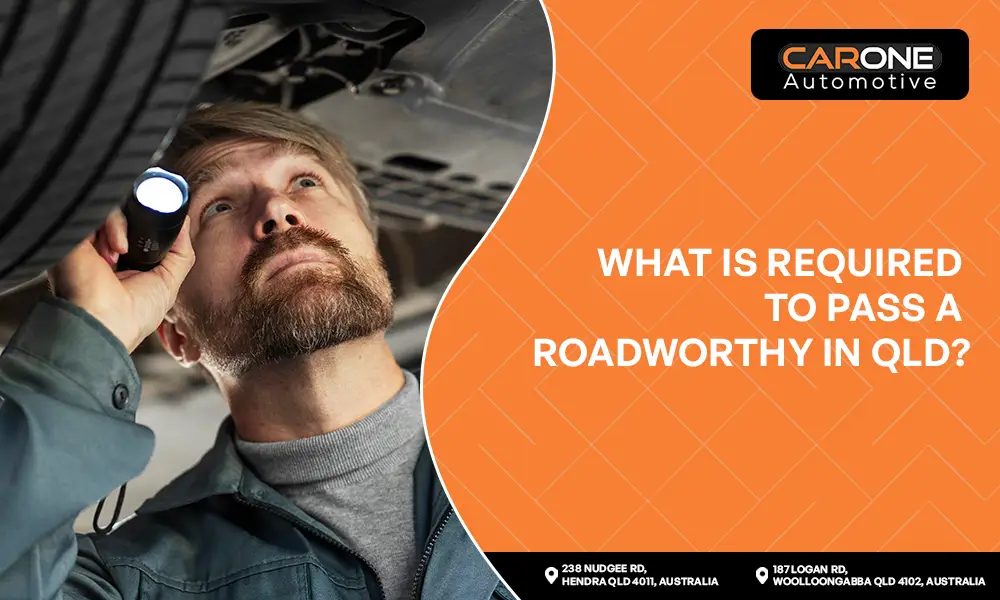
Knowing exactly what gets checked in a Queensland roadworthy helps you avoid failed inspections and re-inspection fees. Most of what is required to pass a roadworthy in QLD comes down to basic safety items you can check yourself before booking, including tyres, brakes, lights, steering, suspension, seatbelts, and windscreen condition.
This is the full 2026 checklist of what is required to pass a roadworthy in Queensland, category by category, with the specific standards that inspectors apply.
Here is what this guide covers:
- Brakes, steering and suspension standards
- Tyres and wheels
- Lights, indicators and reflectors
- Body, windscreen and seatbelts
- Exhaust and emissions
What is Required to Pass a Roadworthy in QLD?
To pass a Queensland roadworthy, a vehicle must meet minimum standards across brakes, steering, suspension, tyres, lights, windscreen, body, seatbelts, exhaust, emissions and any structural modifications, all assessed against Queensland safety standards by a certified inspector.
The inspection is carried out by a licensed inspector at an Approved Inspection Station (AIS). The standards are set by the Department of Transport and Main Roads and apply to every vehicle regardless of age, make or how recently it was serviced. The RWC is not a mechanical service report. It is a formal safety assessment, and the result is binary: the vehicle either meets the minimum standards or it does not.
For a broader guide to how the Queensland roadworthy process works from preparation through to certification, the Passing a Queensland Roadworthy Guide walks through the full process in detail.
Brakes, Steering and Suspension Requirements
Brakes must apply evenly across both axles with no fluid leaks or worn pads below minimum thickness, steering must operate smoothly without excessive play or knocks, and suspension must hold the vehicle level with no broken springs or worn bushes affecting safe handling.
Brakes
The brake system is assessed for both function and condition. Inspectors check that braking force is balanced across each axle, that brake pads and shoes have sufficient material remaining, that rotors and drums are within serviceable limits, and that brake lines show no signs of leaking or corrosion. The handbrake must hold the vehicle stationary on a slope. Any brake fluid leak is a fail.
Steering
Steering is assessed for free play at the wheel, smooth operation through the full lock-to-lock range, and the condition of all steering components including tie rods, rack boots and steering column joints. Excessive knocking or vibration through the steering wheel under assessment conditions will be flagged.
Suspension
Suspension components must support the vehicle level with no visible sag or tilt. Shock absorbers are tested for effective damping. Broken or cracked springs, seized bushes, worn ball joints and loose control arms are all fail items. The inspector will also assess whether any suspension modifications have been made outside approved limits.
For vehicles that need brake work before presenting for inspection, Brake Pad Replacement Brisbane covers what the repair process involves and what to expect.
Tyre and Wheel Requirements
Tyres must have tread depth above 1.5 mm across the full width and circumference, no cuts, bulges or sidewall damage, matching specifications across each axle, and wheels must be securely mounted with no cracks or missing nuts.
Tread Depth
The 1.5 mm minimum applies across the full contact width of the tyre, not just the centre. Uneven wear that brings any section of the tyre below the limit is a fail. Most tyres have tread wear indicators molded into the grooves, and any tyre showing these indicators at the tread level will not pass.
Tyre Condition
Sidewall cracking, bulging, cuts or cord exposure are all automatic fail items regardless of remaining tread depth. A tyre can have adequate tread but still fail on structural grounds if the sidewall or bead area is compromised.
Matching Specifications
Tyres must match in load rating and speed rating across each axle. Mismatched tyre sizes that fall outside the vehicle’s approved specification are a fail unless supported by an appropriate modification approval.
Wheels
Wheels must be free of cracks, particularly around stud holes and the barrel. All wheel nuts must be present and correctly torqued. Aftermarket wheels outside the factory specification require modification documentation.
For a tread depth check and tyre condition assessment before your inspection, Brisbane Tyre Service can assess and replace tyres that are unlikely to pass.
Light and Indicator Requirements
All headlights, brake lights, indicators, reverse lights, number plate lights, hazard lights and reflectors must operate correctly with the correct colour, brightness, and beam pattern, including correctly aligned high and low beam patterns.
Headlights
Both headlights must work on low and high beams. Beam alignment is assessed to confirm the lights are aimed correctly and not blinding oncoming drivers or pointing at the road surface. Headlights that are faded, yellowed or producing insufficient output may be flagged. Non-ADR-compliant LED or HID conversions are a fail unless properly certified.
Brake Lights and Indicators
All brake lights must illuminate when the brake pedal is pressed. Indicators must flash at the correct rate, front and rear, on both sides. A single blown globe in any of these circuits is a fail.
Additional Lights
Reverse lights must illuminate when reverse gear is selected. The number plate light must be operational. Hazard lights must flash all four indicators simultaneously. Any reflectors required by the vehicle’s original specification must be present and undamaged.
Colour Compliance
Indicator lenses must be amber at the front and amber or red at the rear. Headlights must produce white light. Non-standard coloured globes or LED conversions that produce incorrect colour output are a fail.
To understand what fails most often across all lighting and other inspection categories, What Fails a Roadworthy Most Often provides the full breakdown with frequency data.
Body, Windscreen and Seatbelt Requirements
The body must be structurally sound with no rust compromising chassis integrity, the windscreen must be free of cracks or chips in the driver’s vision area, seatbelts must retract and lock correctly, and doors must open, close and latch as designed.
Body and Chassis Integrity
Inspectors assess the body for rust or corrosion that compromises the structural integrity of the chassis, sill sections, floor pan or strut towers. Surface rust on non-structural panels is treated differently from rust that penetrates or weakens structural members. Sharp or jagged body edges that could cause injury are also flagged.
Windscreen
Any crack or chip that falls within the critical vision zone, which covers the area directly in the driver’s line of sight, is a fail. Damage outside this zone may be assessed on its severity and whether it is likely to spread. Windscreen tinting must also comply with legal visible light transmission requirements.
Suspension and Body Interaction
Where suspension modifications have altered ride height or changed the relationship between the body and the wheels, inspectors will look for evidence of tyre-to-arch contact, rubbing or clearance issues that create a safety risk. These are assessed as part of the overall body and suspension review.
Seatbelts
Every seatbelt fitted to the vehicle must retract smoothly, lock under load, and release cleanly from the buckle. Frayed or cut webbing, a buckle that does not engage positively, or a retractor that does not hold the belt in place are all fail items. Seatbelts that have been involved in a collision should be replaced regardless of apparent condition.
Doors, Bonnet and Boot
All doors must open from both inside and outside, close fully and latch securely. The bonnet must latch and not open while driving. The boot or tailgate must close and latch correctly.
If you have questions about whether a specific item on your vehicle is likely to be flagged, the guide on How to Spot a Dodgy RWC explains what appropriate inspection practice looks like and how to identify assessments that may not be conducted properly.
Exhaust and Emissions Requirements
The exhaust system must be securely mounted with no leaks, mufflers and catalytic converters fitted as designed, emissions must comply with ADR standards for the vehicle’s age, and noise must not exceed legal limits for the make and model.
Exhaust System Condition
The exhaust must be complete from the manifold to the tailpipe with no missing sections, holes or separated joints. Leaks that allow exhaust gases to enter the cabin are a serious fail. The system must be securely mounted with no loose or broken hangers that could allow the exhaust to contact the road surface.
Emissions Standards
Emissions compliance is assessed relative to the ADR standards applicable to the vehicle’s year of manufacture. A pre-1986 vehicle is assessed against different standards than a modern vehicle fitted with a catalytic converter. Visible smoke from the exhaust during the inspection is a clear indicator of a potential emissions fail.
Noise Levels
Exhaust noise must not exceed the legal limit for the vehicle type. Aftermarket exhausts that increase noise output above the approved level are a fail, even if they were purchased as a direct replacement part.
Catalytic Converters and DPFs
Removing or bypassing emissions control components including catalytic converters and diesel particulate filters (DPFs) is illegal and will result in an automatic fail. Vehicles with these components removed or modified will not pass regardless of other condition factors.
Modifications and Aftermarket Parts
Modifications must comply with Australian Design Rules and have correct modification plate approval where required, including suspension changes, exhaust changes, engine swaps, body modifications, wheel and tyre changes outside factory specification, and lighting upgrades.
The RWC inspection items for modified vehicles follow the same safety standards as unmodified vehicles, but an additional layer of documentation is required. Any modification that falls outside the vehicle’s original ADR specification must be supported by either a Queensland Transport approval or an engineering certificate accompanied by a modification plate.
Common Modifications That Require Documentation
- Suspension lifts or lowering beyond approved limits
- Engine conversions or transplants
- Transmission changes
- Wheel and tyre combinations outside the factory specification
- Aftermarket exhaust systems on vehicles subject to noise and emissions standards
- Structural additions including bull bars, tow bars and roof racks that affect the vehicle’s weight distribution or safety systems
- Window tinting applied to front side windows or the windscreen
What Happens Without Documentation
If a modification cannot be verified as compliant through documentation presented at the time of inspection, the inspector has no basis to certify it. The vehicle will fail on that item. The solution is to obtain the relevant engineering certificate or modification approval before the inspection date, not after.
For the full inspection and booking process for a Brisbane RWC, Brisbane Roadworthy Bookings covers what to expect and how to prepare your vehicle before arriving.
Conclusion
Passing a Queensland roadworthy test is a process of matching your vehicle against a defined checklist of safety standards. Most of what is required is easy to pre-inspect at home, and most fail items are inexpensive to fix once identified. Working through the checklist before your formal inspection date removes the uncertainty and turns the RWC into a confirmation of what you already know.
For a Brisbane pre-inspection check before the formal RWC, Car One Automotive can identify and fix anything that would have failed, before it becomes a fail on the official report.
Frequently Asked Questions
What Is Required to Pass a Roadworthy in QLD?
A vehicle must meet Queensland Transport’s minimum safety standards across brakes, steering, suspension, tyres, lights, windscreen, body structure, seatbelts, exhaust and emissions. Any aftermarket modifications must also comply with Australian Design Rules and carry the appropriate modification plate where required.
What Is the Minimum Tyre Tread for a QLD RWC?
The minimum tyre tread depth in Queensland is 1.5 mm, measured across the full width of the tyre contact patch. Uneven wear that brings any section of the tyre below this depth is a fail. Tyres showing tread wear indicators at tread level will not pass the inspection.
Will a Chipped Windscreen Fail a Roadworthy?
A chip or crack in the driver’s critical vision zone is a fail. Damage outside this zone may or may not be flagged depending on its size, severity and whether it is likely to spread. When in doubt, have the chip assessed or repaired before the inspection rather than hoping for a favourable result.
Do Aftermarket Exhausts Pass a Roadworthy?
An aftermarket exhaust can pass if it meets ADR noise and emissions standards for the vehicle. Systems that increase noise above the legal limit or remove emissions control components including catalytic converters are an automatic fail. A compliance certificate from the manufacturer does not guarantee Queensland roadworthy approval.
What If I Have a Small Oil Leak?
Minor seepage that leaves residue on components but does not drip actively may be assessed differently from an active drip at inspection time. An oil leak that is severe enough to contaminate brake or clutch components, or that poses a road surface hazard, is a fail. Address any known leaks before the inspection to avoid uncertainty.