The timing belt or chain is one of the most important parts in your engine, and also one of the least understood until it causes a very expensive problem.
This guide explains the difference between a timing belt and a timing chain, how to tell which your car has, how long each lasts, and why replacing a belt on time matters so much. Understanding it helps you avoid one of the most costly failures a car can suffer.
Here is what we cover:
- The difference between a belt and a chain
- Which does your car have
- How long each lasts
- The warning signs of a problem
- What replacement costs and why it matters
What’s the difference between a timing belt and a timing chain?
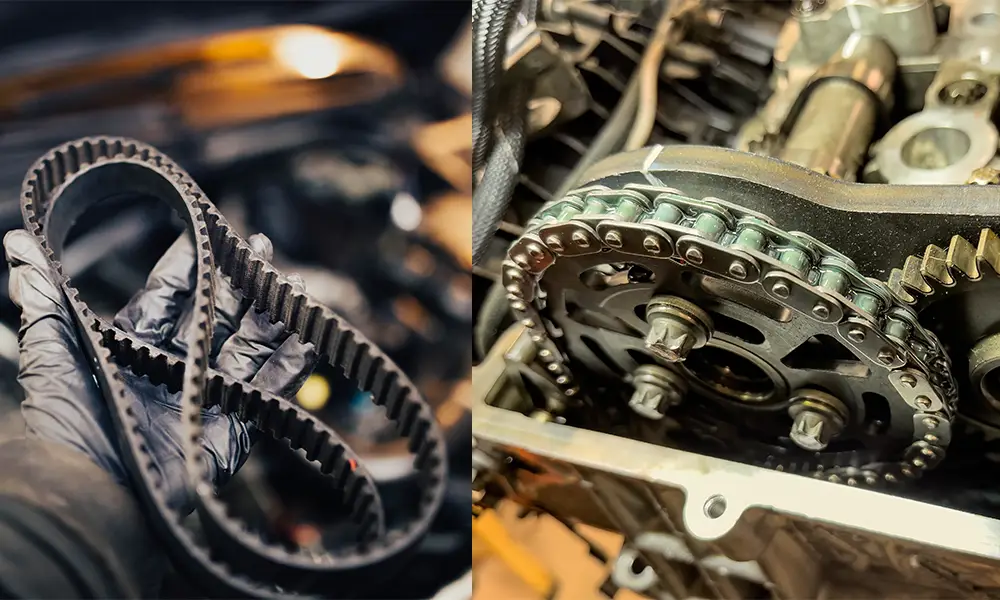
The difference is that a timing belt is a rubber toothed belt that must be replaced at set intervals, while a timing chain is a metal chain designed to last much longer, often the life of the engine, though both do the same job of keeping the engine’s valves and pistons in time.
Both components perform the same critical task, which is keeping the top of the engine, where the valves open and close, perfectly synchronised with the bottom, where the pistons move up and down. If that synchronisation is lost, the engine cannot run and, on many engines, serious damage follows. The whole timing belt vs timing chain question really comes down to the material used for that job, and the very different maintenance each one needs as a result.
A rubber belt is quieter and lighter but wears out, so it comes with a scheduled replacement, while a metal chain is more durable and usually lasts far longer, but it is not entirely maintenance-free. The table below sets the two side by side so the practical differences are clear.
| Timing belt | Timing chain | |
|---|---|---|
| Material | Rubber, toothed | Metal chain |
| Lifespan | Set interval | Often engine life |
| Replacement | Scheduled | Only if it fails |
| Warning | Few, replace on time | Rattle when worn |
| Cost if it fails | High (engine damage) | High |
What does the timing component do?
It keeps the valves and pistons synchronised. The belt or chain links the top and bottom of the engine so they move in perfect time, and if that timing is lost the engine cannot run and, on many engines, the valves and pistons can collide.
Why does the material matter?
Rubber wears out; metal lasts longer. A rubber belt is quiet and light but degrades over time and needs replacing on schedule, whereas a metal chain is far more durable and often lasts the life of the engine, which is the main practical difference between them.
Which does your car have, a belt or a chain?
Whether your car has a timing belt or chain depends on the make, model and engine, and the surest way to know is to check the manufacturer’s handbook or ask a mechanic, since it determines whether you have a scheduled replacement to plan for.
There is no way to tell simply from the badge, because manufacturers use both across their ranges, and even the same model can differ between engine options and model years. This matters a great deal for planning, because a belt-driven engine has a replacement interval you need to budget for, while a chain-driven one usually does not. If you are not certain which your car has, our Brisbane mechanics can confirm it and tell you whether a replacement is due or coming up.
Knowing which you have also changes how you read the car’s behaviour, since the warning signs differ between the two. It is one of the more useful things to establish about a car, especially a used one, so you are not caught out by a maintenance cost you did not know was coming.
This is one of the most useful things to establish when buying a used car in particular, because a belt-driven engine carries a maintenance cost the previous owner may or may not have kept up with. If the car is due for a belt change soon, that is a real expense to factor into the price, and if there is no record of the belt ever being done at the recommended interval, it is safest to assume it needs doing. A chain-driven engine avoids that particular worry, though it is not entirely free of maintenance either. Either way, knowing which your car has turns a hidden risk into a known quantity, so you can plan for it rather than be surprised by it, and it is a simple question a mechanic can answer for you in moments.
How do I check which I have?
Handbook, or a mechanic can confirm. The owner’s handbook usually states whether the engine uses a belt or a chain, and a mechanic can confirm it quickly, which is worth doing so you know whether a scheduled replacement applies to your car.
Does it change my servicing?
A belt adds a scheduled replacement. If your car has a timing belt, you need to plan and budget for replacing it at the manufacturer’s interval, whereas a chain-driven engine generally has no such scheduled job, which makes its long-term maintenance simpler.
How long does a timing belt last?
A timing belt typically lasts around 60,000 to 100,000 kilometres or a set number of years, depending on the manufacturer, after which it must be replaced, often together with the water pump and tensioner while the area is open.
The exact interval varies between manufacturers and engines, so the figure in your handbook is the one to follow, but the important point is that a belt has a definite lifespan and must be replaced before it reaches the end of it. Because the belt runs on a tensioner and often sits alongside the water pump, a sensible timing belt replacement does those parts at the same time, since much of the labour is in getting to the area. Keeping on top of jobs like this is part of the wider approach our guide to maintenance habits worth keeping describes.
Doing the water pump together is not upselling, it is efficiency, because replacing it separately later would mean paying for much of the same labour twice. When your belt interval is approaching, you can book a service in Brisbane to have the belt, tensioner and water pump done together, which is the cost-effective way to handle it.
Why replace the water pump too?
It’s in the same area, efficient to do together. The water pump usually sits behind or beside the timing belt, so replacing both at once saves paying twice for the same labour, which is why it is standard practice to do the water pump during a belt change.
What if I miss the interval?
Rising risk of belt failure and engine damage. A belt left past its interval becomes more likely to snap, and on an interference engine that can cause the valves and pistons to collide, turning a planned maintenance cost into a major engine repair.
What are the warning signs and what does replacement cost?
A timing chain may rattle when worn, while a timing belt usually gives little warning and should be replaced at the manufacturer’s recommended interval. Timing belt replacement in Brisbane typically costs $700–$1,800, depending on the vehicle, making it far less expensive than the major engine repairs a snapped timing belt can cause.
This is the key difference in how the two announce a problem. A worn chain often gives you a warning in the form of a rattle, especially on start-up, which is your cue to have it checked. A belt, by contrast, gives very little warning before it fails, which is exactly why it is replaced on a schedule rather than when symptoms appear. If your engine is making unusual noises, our guide to how to tune a car engine covers some of the related running issues worth understanding.
Because a chain rattle or a rough-running engine can have several causes, a proper diagnosis matters, and a diagnostic check helps confirm what is actually going on before any major work. The cost of replacing a belt is modest set against the alternative, since a snapped belt on an interference engine can mean a rebuild, making on-time replacement one of the clearest examples of cheap prevention.
What does a worn chain sound like?
A rattle, especially on start-up. A worn or stretched timing chain often produces a rattling noise, most noticeable when you first start the engine, and our guide to how an engine misfire is diagnosed covers how such noises and running issues are traced to their cause.
Why is replacing a belt on time vital?
A snap can destroy an interference engine. On an interference engine, if the belt breaks the valves and pistons can collide, causing major and expensive damage, so replacing the belt on schedule, before it can fail, is far cheaper than the repair.
Conclusion
A timing belt is a scheduled replacement you plan for, while a chain is usually left until it shows symptoms, and ignoring a belt interval risks catastrophic engine damage. Knowing which your car has, and staying on schedule, is what protects the engine. If you are unsure or your belt is due, Car One Automotive can check it and advise.
Frequently Asked Questions
What’s the difference between a timing belt and chain?
A timing belt is a rubber toothed belt that must be replaced at set intervals, while a timing chain is metal and often lasts the life of the engine. Both do the same job of keeping the engine’s valves and pistons perfectly in time with each other.
How do I know if my car has a belt or a chain?
Check the manufacturer’s handbook or ask a mechanic, as manufacturers use both across their ranges. It matters because a belt has a scheduled replacement you need to plan and budget for, while a chain-driven engine usually has no such fixed replacement job.
How long does a timing belt last?
Typically around 60,000 to 100,000 kilometres or a set number of years, depending on the manufacturer, so the figure in your handbook is the one to follow. It should be replaced on schedule, usually together with the water pump and tensioner while the area is open.
What happens if a timing belt breaks?
On an interference engine, a snapped belt lets the valves and pistons collide, causing major and expensive engine damage that can mean a rebuild. That is exactly why the belt is replaced on a schedule, before it can fail, rather than waiting for a warning that rarely comes.
Does a timing chain need replacing?
Usually only if it fails or becomes worn, which often shows up as a rattle, especially on start-up. Unlike a belt, it is not typically on a fixed replacement schedule, so it is generally left in place until symptoms suggest it needs attention.