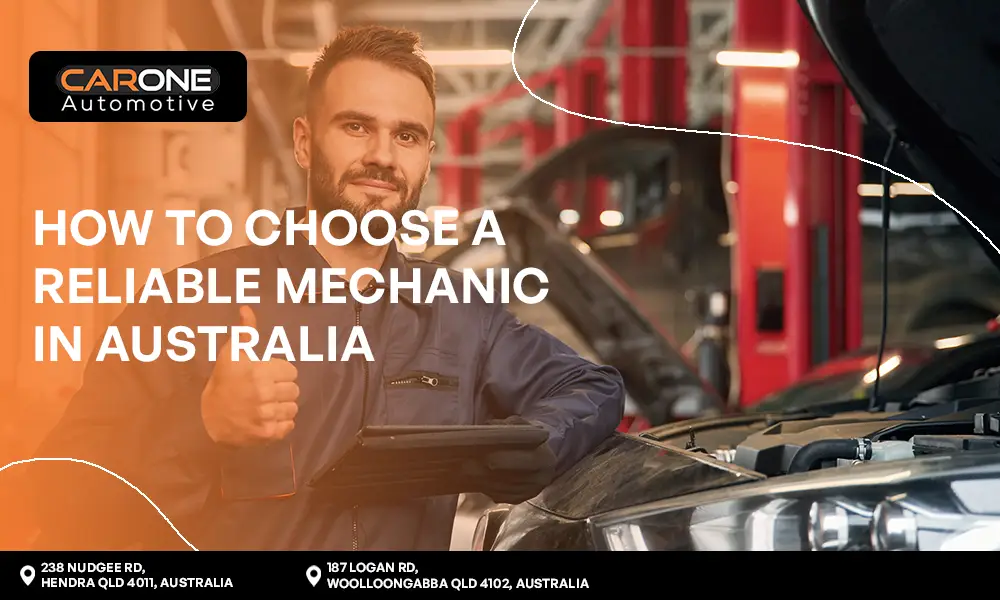
Finding a reliable mechanic you can actually trust is one of those frustrating tasks every Australian driver faces eventually, and usually after a bad experience that costs them a few hundred dollars more than it should have.
A good mechanic is more valuable than most drivers realize and the certified mechanics who stand behind their work make the difference between a car that runs well for 300,000 km and one that develops expensive, avoidable faults.
This guide explains exactly how to choose a reliable mechanic in Australia: the credentials that matter, the questions that separate honest workshops from sales-driven ones, and the red flags worth walking away from.
Here is what this guide covers:
- What actually makes a mechanic reliable, in measurable terms
- The credentials and certifications to verify before booking
- Five questions to ask before they touch your car
- Red flags that signal it is time to find another workshop
- What you should expect to pay for honest, qualified work
- Your rights under Australian Consumer Law
- How to find a trustworthy mechanic specifically in Brisbane
What Makes a Mechanic Reliable?
A reliable mechanic in Australia is a qualified technician with a current MTA or industry certification, a physical workshop with verifiable public reviews, transparent pricing, written quotes before work begins, and a willingness to show you the replaced parts after any major repair.
Reliability in a mechanic is not just a feeling. It is a set of measurable, verifiable characteristics that you can confirm before you hand over your keys. Breaking the Breaking down the definition into its components makes it practical to apply when you are assessing an unfamiliar workshop.
Trade Qualifications
In Australia, automotive technicians should hold a Certificate III in Light Vehicle Mechanical Technology or an equivalent trade qualification. This is the minimum standard for someone working unsupervised on passenger vehicles. The qualification is issued through registered training organizations and results in a formal trade certificate that a legitimate workshop will have no hesitation displaying or discussing.
Industry Membership
The Motor Trades Association of Queensland (MTA Queensland) is the primary industry body for automotive workshops in the state. MTA membership indicates a workshop has agreed to the association’s code of conduct, which includes commitments to honest quoting, workmanship standards, and dispute resolution. It is not a guarantee of quality, but it provides an accountability layer that unaffiliated workshops do not have. The Institute of Automotive and Mechanical Engineers (IAME) and the Australian Motor Repair Trades Association (AMRTA) are additional bodies that represent qualified professionals.
Physical Presence and Public Reviews
A reliable workshop has a verified physical address, not just a mobile service number. It has a history of public reviews across Google, True Local, or similar platforms that can be assessed for patterns rather than just star ratings. A workshop with 200 reviews averaging 4.6 stars across three years is a more reliable signal than one with 12 reviews all posted within a month.
Written Quotes and Returned Parts
Any workshop worth using will provide a written quote before starting work and will return major parts that were replaced on request. These two practices are the most obvious signs of a workshop that has nothing to hide. A workshop that resists either of these practices is giving you a reason to go elsewhere.
For a full understanding of what the logbook service process looks like from a properly qualified workshop, the Logbook Service Brisbane Guide covers every stage in a manufacturer-compliant service from intake through to the final stamp.
For practical guidance on assessing workshops before booking, How to Choose a Workshop Near You gives a location-specific framework for evaluating options in your area.
What Questions Should You Ask a Mechanic?
The five questions worth asking any mechanic before booking are: are you licensed and certified, can you provide a written quote before starting work, will you show me the old parts after the repair, do you guarantee your workmanship, and can I see current customer reviews?
Understanding how to choose a mechanic comes down to knowing which questions produce useful answers and which ones produce vague ones. A workshop that answers all five of the above with clear, direct responses is demonstrating transparency in a meaningful way. A workshop that deflects, qualifies, or evades any of them shows how it will behave if something goes wrong later.
Question 1: Are You Licensed and Certified?
The answer you want is a specific yes, accompanied by either a displayed certificate or the name of the certification body and the technician’s qualification level. The answer to avoid is a vague yes without supporting information, or a response that conflates having an ABN with being trade-qualified.
Question 2: Can You Provide a Written Quote Before Starting Work?
Transparent pricing means a written quote that specifies parts, labour, and any known variables before work begins. The quote should include the labour rate per hour and an estimate of hours, or a flat rate for the job. Verbal estimates that shift when you collect the car are a common source of disputes and a reliable indicator of how the workshop manages customer expectations.
Question 3: Will You Show Me the Old Parts After Replacement?
Returning old parts on request is standard practice at honest workshops and a practical way to verify that the work was actually done. A workshop that replaced your brake pads will have four old pads to show you. One that replaced only two but charged for four will be reluctant to produce them. This question is not about distrust. It is about verification.
Question 4: Do You Guarantee Your Workmanship?
A reliable mechanic will offer a workmanship warranty on parts they have installed. The standard is parts and labour coverage for 12 months or a specified kilometre period. Some workshops offer longer guarantees. The specific terms matter less than the willingness to put them in writing. A warranty that exists only verbally provides limited practical protection.
Question 5: Can I See Current Customer Reviews?
Asking for current reviews, not testimonials curated by the workshop itself, gives you access to independent assessments of real service experiences. A workshop confident in its work will direct you to its Google listing without hesitation. Reviews that are entirely positive with no variation in language or timing often indicate review manipulation rather than genuine feedback.
For an additional perspective on evaluating mechanics before you book, Peek Under the Hood Guide provides complementary guidance on the assessment process from a driver’s perspective.
What Are the Red Flags of an Unreliable Mechanic?
The red flags of an unreliable mechanic include refusing to provide written quotes, pressuring for additional work without explanation, having no current certification on display, refusing to return replaced parts, declining to put workmanship guarantees in writing, and review patterns that reflect consistent complaints about billing or communication.
A trusted mechanic demonstrates their integrity through process, not personality. The most persuasive workshops are not always the most reliable ones. Looking for process-based signals rather than rapport-based ones gives you a more reliable assessment of what the workshop will actually deliver.
The most significant red flags to watch for include:
Verbal-Only Quotes That Later Increase
A workshop that provides a verbal estimate of $400 and presents a bill of $800 at collection is not experiencing bad luck. It is operating a pricing model that depends on commitment bias: the customer is less likely to dispute a bill for completed work than to decline a quote for uncommenced work. Always insist on a written quote with a variation approval threshold before work begins.
Pressure to Authorise Additional Work Immediately
A legitimate additional fault identified during a service deserves a phone call with a written quote before any work proceeds. A workshop that phones to say they have found something and immediately pressures approval without allowing time to consider, get a second opinion, or ask clarifying questions is not operating in the customer’s interest.
No Certification or Qualification Displayed
Trade qualifications and MTA membership certificates are typically displayed in the workshop reception area. A workshop that cannot or will not show evidence of trade qualifications is a workshop where you cannot verify that the person working on your car holds the minimum qualification required to do so safely.
Inability or Reluctance to Return Replaced Parts
Replaced parts should be available for customer inspection at collection. If a workshop tells you the parts have already been disposed of immediately after a same-day service, such an assertion is worth questioning. Workshop waste disposal processes do not prevent returning parts to the customer who paid for them.
Review Patterns Indicating Billing Disputes
A workshop with multiple one-star reviews citing unexpected charges, work not authorised, or billing disagreements is showing you a consistent pattern rather than isolated incidents. One negative review in 200 is noise. Five reviews out of 80 with the same complaint indicate a pattern.
For a comprehensive breakdown of specific dishonest practices and how to identify them before and after a service, How to Spot a Dishonest Mechanic covers the warning signs that Brisbane drivers should know before choosing a workshop.
How Much Should You Pay a Reliable Mechanic?
A reliable Australian mechanic typically charges between $110 and $185 per hour in labour, with parts charged at or close to the recommended retail price. Labour rates significantly below this range is a quality warning, and rates significantly above it should be justified by specialist skills, manufacturer-specific tooling, or complex vehicle categories.
The labour rate range reflects the cost of operating a legitimate workshop in Australia. Trade wages, workshop lease, insurance, diagnostic equipment, and ongoing training all contribute to the hourly rate a qualified workshop needs to sustain itself. A $60 per hour labour rate does not cover these costs without compromising somewhere, and the somewhere is usually in training, tooling, or parts quality.
Parts pricing deserves separate attention. Reliable car service means parts charged at or close to recommended retail, not at inflated margins that significantly exceed what you could purchase the part for independently. A common legitimate markup for workshopping is 20% to 40% on parts, which reflects purchasing, handling, and warranty administration costs. Parts charged at 200% above retail are a billing practice worth questioning.
The total cost of a service is the best verification tool. A logbook service quoted at $150 all-in is not providing a complete logbook service. Understanding what is included in the scope of the service and what that scope costs at a legitimate workshop gives you the reference point to assess whether a quote is competitive or suspiciously cheap.
For practical guidance on getting honest value from Brisbane workshops without overpaying, Insider Servicing Secrets gives a direct breakdown of where legitimate cost savings are available and where they are not.
For the full picture of what each service interval should include and what those scopes cost, the Service Intervals Guide maps every interval from the first service through to major milestone maintenance.
For transparent pricing across all service types in Brisbane, Car Servicing Brisbane provides clear pricing for logbook and general maintenance on all makes and models.
Are Independent Mechanics as Reliable as Dealerships?
Yes. Certified independent mechanics in Australia are legally and practically as reliable as dealerships for most vehicles, and are often the better choice for vehicles out of warranty. Australian Consumer Law explicitly guarantees that independent workshops can perform manufacturer-specification work and stamp logbooks legitimately without voiding manufacturer warranties.
The dealership-or-warranty-voiding myth is one of the most persistent and consequential pieces of misinformation in the Australian automotive industry. Many drivers pay dealership prices for their entire warranty period because they believe they have no choice. They do have a choice, and the Australian Consumer Law makes it explicit.
Under the Australian Consumer Law, a manufacturer cannot make warranty validity conditional on the use of their dealership network for servicing. What the manufacturer can legitimately require is that the vehicle is serviced to their specification using approved parts and procedures and that the service is properly recorded in the logbook. An independent workshop that meets these requirements provides legally equivalent warranty compliance to a dealership service.
In practical terms, certified independent mechanics in Brisbane typically charge 20% to 40% less than authorized dealerships for comparable logbook services. The service scope is the same when the independent workshop follows the manufacturer’s specification. The difference is entirely in pricing structure, as dealerships operate with higher fixed costs, including showroom facilities, demonstrator fleets, and brand representation expenses that independent workshops do not carry.
The appropriate time to use a dealership is for manufacturer warranty claims, recall rectifications, and complex diagnostics on newer vehicles where the manufacturer’s proprietary scan tools are required. For routine logbook servicing, an independent workshop with the correct manufacturer training and tooling provides equivalent compliance at a lower cost.
How Do You Verify a Mechanic’s Certification?
Verify a mechanic’s certification by checking the MTA Queensland member register, looking for trade qualification certificates displayed in the workshop, asking which manufacturer-specific training the technicians hold, and confirming that the workshop’s ABN on the Australian Business Register matches the trading name of the business.
The MTA Queensland member directory is publicly accessible and allows drivers to confirm whether a workshop holds current membership in the association. Membership indicates the workshop has agreed to the MTA’s code of conduct and has access to the association’s dispute resolution process.
Trade certificates should be displayed in the workshop reception area or customer waiting space. A Certificate III in Light Vehicle Mechanical Technology is the foundation qualification. Additional manufacturer-specific training certificates from brands such as Toyota, Bosch, or Delphi indicate technicians with specialist knowledge beyond the general trade qualification.
The ABN Lookup tool at abr.business.gov.au allows anyone to verify that a business ABN is active and matches the trading name provided. A workshop operating under a name that does not match its registered ABN, or with a cancelled or inactive ABN, is a business operating outside normal accountability structures.
These verification steps take five minutes and are worth doing before booking any workshop you have not used before. The certified mechanics who welcome this due diligence are demonstrating exactly the transparency you are looking for. The ones who resist it are telling you something important.
How Do You Find a Reliable Mechanic in Brisbane?
To find a reliable mechanic in Brisbane, combine Google review trends with MTA Queensland member status, a physical workshop you can visit in person, transparent pricing available on their website or on request, and a clear willingness to provide written quotes before any work begins. The best mechanic in Brisbane for your vehicle is the one who meets all of these criteria and has a track record across the specific service types you need.
Brisbane’s automotive market is large enough to provide genuine choice. The challenge is not a lack of options but a lack of consistent signals for distinguishing the reliable workshops from the average ones. The framework below makes the search systematic rather than luck-dependent.
Step 1: Start with Google Reviews, Not Star Ratings
Look for workshops with a high volume of reviews across a consistent timeframe, at least 100 reviews spread over 12 months or more. Read the negative reviews first. A reliable workshop’s negative reviews typically involve isolated incidents or miscommunication rather than billing disputes or incomplete work. Patterns in negative reviews are more revealing than the star average.
Step 2: Confirm MTA Queensland Membership
Check the workshop against the MTA Queensland member directory. Membership is not a performance guarantee, but it provides an accountability structure and dispute resolution pathway that non-members do not offer. A workshop that has maintained MTA membership for five or more years has operated within an accountability framework through multiple customer relationships.
Step 3: Visit Before You Book
Drive past or visit the workshop before booking. A well-maintained reception area, organised workshop floor, and professional presentation are practical indicators of how the business operates. A chaotic, poorly maintained workshop is telling you something about its management standards that reviews alone cannot.
Step 4: Request a Written Quote for a Known Service
Contact the workshop and request a written quote for a specific service you know you need, such as a logbook service at a specific kilometre interval. Compare the scope against what that interval requires. A workshop that quotes a 60,000 km logbook service at $180 is not delivering a 60,000 km scope. A workshop that quotes $450 to $550 and lists the included items is demonstrating honest, transparent pricing.
Step 5: Ask About Manufacturer Training for Your Vehicle
If you drive a European vehicle or a less common make, ask specifically whether the workshop has training and tooling for your vehicle type. Not every workshop is equally equipped for every manufacturer. A workshop that is honest about its limitations is more reliable than one that claims equal competence across every make on the market.
For further reading on building a long-term relationship with a workshop you can rely on, Secure Your Car’s Future provides practical guidance on moving beyond convenience-based workshop selection to trust-based long-term partnerships.
To connect with qualified and verified mechanics in Brisbane directly, Certified Mechanics Brisbane covers all makes and models with transparent pricing and logbook-compliant servicing across the region.
Conclusion
Choosing a reliable mechanic is part research and part instinct, and once you know what to look for, the research becomes straightforward. Certification, transparency, written quotes, and returned parts are the four practical signals that separate honest workshops from the ones you will regret using. Australian Consumer Law gives you the right to use any qualified workshop for warranty-compliant servicing, which means you are never locked into a dealership relationship by anything other than habit.
The best workshop for your vehicle demonstrates all four signals before the first service and consistently across every subsequent visit.
For reliable, transparent servicing across Brisbane, Car One Automotive backs every job with the written quote, the returned parts, and the workmanship standard you deserve.
Frequently Asked Questions
How Do I Know If a Mechanic Is Reliable?
A reliable mechanic holds a current trade qualification such as a Certificate III in Light Vehicle Mechanical Technology, provides written quotes before starting work, returns replaced parts on request, displays certifications in the workshop, and has a consistent track record of positive public reviews. All of these can be verified before you book.
Can Independent Mechanics Legally Service My Car Under Warranty?
Yes. Under Australian Consumer Law, any qualified independent mechanic can service your vehicle and stamp your logbook without voiding your manufacturer’s warranty. The manufacturer cannot require you to use their dealership network. They can only require that the service follows their specification using approved parts and that the logbook is properly documented.
What Hourly Rate Should a Mechanic Charge in Australia?
A qualified mechanic in Australia typically charges $110 to $185 per hour in labour. Rates below this range may indicate unqualified labour, poor-quality parts, or an incomplete work scope. Rates above this range should be justified by specialist manufacturer training, complex vehicle categories, or advanced diagnostic equipment relevant to your vehicle type.
How Do I Verify a Mechanic’s Certifications?
Check the MTA Queensland member directory online. Look for trade qualification certificates displayed in the workshop reception area. Ask which manufacturer-specific training the technicians hold. Verify the workshop’s ABN against the Australian Business Register at abr.business.gov.au to confirm the business name and trading status match. These checks take five minutes combined.
What Should I Do If a Mechanic Does Dishonest Work?
First, raise the issue directly with the workshop in writing and request a resolution. If unresolved, lodge a complaint with MTA Queensland if the workshop is a member or with the Office of Fair Trading Queensland. You may also have remedies under Australian Consumer Law for services not delivered as described or charged beyond the authorized quote.