Finding a reddish puddle near the front wheels, especially with a whining noise when turning, is a reasonable cause for worry.
This guide shows how to confirm a power steering fluid leak, what usually causes it, and which repairs fix it properly.
Here is what you will learn:
- How to tell power steering fluid from oil, coolant and transmission fluid
- The most common leak sources
- How long you can safely drive with a leak
- Repair options and typical cost bands
- Why Brisbane heat speeds up hose and seal wear
How Can You Tell If the Leak Is Power Steering Fluid?
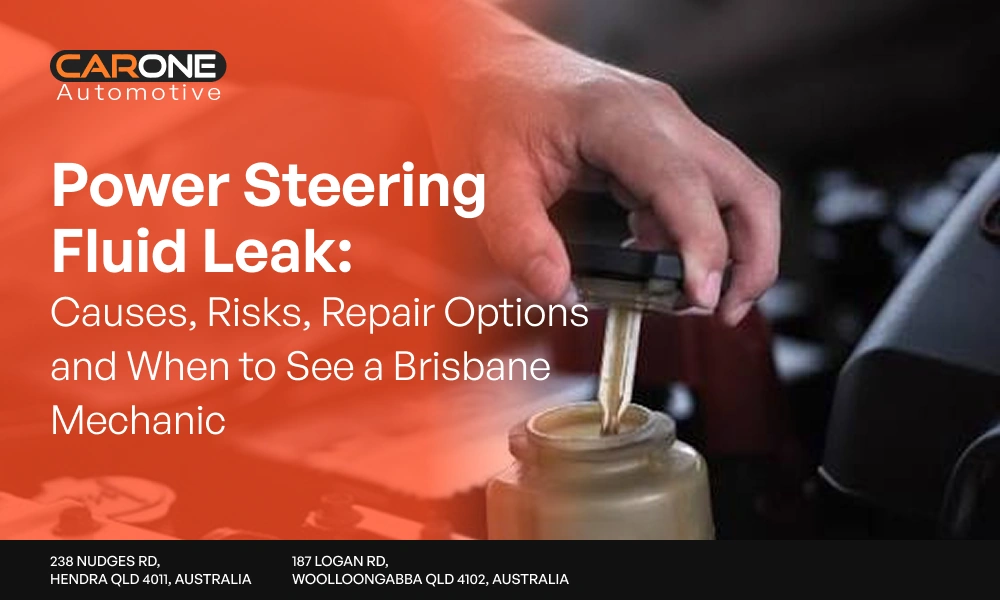
Power steering fluid is usually red, amber or clear, feels thin and oily, and drips near the front of the car around the pump, hoses or steering rack, with the reservoir level dropping. A reddish fluid under car bodywork near the front wheels is the classic sign. Comparing colour and location against the other fluids narrows it down quickly, and owners in Coorparoo QLD 4151 or East Brisbane QLD 4169 often find the stain on a driveway.
- Engine oil: amber to black, thicker, usually under the engine
- Coolant: green, orange or pink, thin, with a sweet smell
- Transmission fluid: red, usually toward the middle of the car
- Brake fluid: clear to yellow, near a wheel or the brake pedal area
Many cars have a translucent fluid reservoir, and a level that falls between cold-engine checks confirms a leak.
Plenty of drips under a car turn out to be coolant rather than steering fluid. If the puddle is green, orange or pink and smells sweet, the coolant leak causes guide explains where that fluid usually escapes, so you can rule out a cooling fault before spending anything on the steering.
For a simple test, slide a sheet of cardboard under the front of the car overnight. In the morning, the spot position and colour show where the fluid is coming from.
If the stain is reddish and sits near the pump or rack, the next step is a proper inspection rather than more guessing. A visit for power steering repair in Brisbane starts with a pressure and visual check of the pump, hoses and rack, so the exact source is confirmed before any part is replaced.
What Causes a Power Steering Fluid Leak?
Most leaks come from perished rubber hoses, loose clamps, a worn pump shaft seal or failed steering rack seals, and age, heat and contaminated fluid speed up all four. The table below links each leak sign to its likely cause and how urgent it is.
| Leak Sign | Likely Cause | Urgency |
| Damp, oily hose near the pump | Perished hose or loose clamp | Book within a week |
| Fluid on the pump body, whining noise | Worn pump shaft seal | Book soon |
| Drips near the inner tie-rod boots | Steering rack seal failure | Book soon; check level daily |
| Reservoir drops between checks, steering heavy | Active leak with low fluid | Stop driving long distances; book now |
A power steering pump leak usually shows as a wet, grimy pump body, often with a whine when you turn. The power steering hose is the most common culprit, because rubber ages, and the steering rack seal is the hardest to see because it hides behind the tie-rod boots.
In our workshop, one heavy-steering complaint was blamed on the pump, but the real fault was a cracked high-pressure hose spraying a fine mist onto the pump. A new hose fixed it.
Not every drip belongs to the steering, and engine oil is the usual confusion for owners who find a dark puddle under the front of the car. A guide on engine oil leak causes shows how oil leaks differ from steering leaks in colour, thickness and position, which helps you rule oil out before the car goes on the hoist.
Is It Safe to Drive With a Power Steering Fluid Leak?
A small leak is not an immediate danger, but running the system low can damage the pump and suddenly make steering heavy when turning, which is risky in traffic and car parks. Brake performance is not affected by a steering fluid leak, but steering effort is. A whining pump is the sound of the pump starting to run short.
Topping up the reservoir buys time and nothing more, because the fluid keeps escaping.
When fluid runs low, the wheel can feel normal on the open road and then become very stiff in a tight turn. Reading about steering hard to turn at low speed explains why heavy steering is most obvious when parking, and which causes are quick to rule out first before you spend anything on parts.
Steering condition also matters at inspection time. Steering components and fluid leaks are inspection criteria for Queensland approved inspectors, as the Queensland Light Vehicle Inspection Manual sets out for inspection staff. A leaking system can therefore become a problem when the car is sold, not just on the road.
What Are the Repair Options for a Power Steering Leak?
Repair options include tightening or replacing clamps, replacing a hose, resealing or replacing the pump, and resealing or replacing the steering rack, with costs rising sharply from hose to rack. Power steering fluid leak repair is cheapest at the clamp and hose end of the list. The table below shows typical 2026 Brisbane prices and times for each repair.
| Repair | Typical Price (AUD) | Typical Time |
| Clamp tightening or replacement | $80 to $150 | 30 to 60 min |
| Hose replacement and fluid bleed | $250 to $600 | 1 to 2.5 hours |
| Pump reseal or replacement | $600 to $1,500 | 2 to 4 hours |
| Steering rack reseal or replacement (plus alignment) | $1,500 to $3,500 | 4 to 8 hours |
A stop leak additive may slow a minor seep for a short time, but it does not repair a cracked hose or a failed rack seal, so it should never be treated as the fix. These figures are typical ranges rather than quotes, and the workshop confirms the final price once the leak source is found.
Drivers who want every price band on one page, including electric systems and alignment, can use the longer breakdown. The power steering repair cost guide covers pumps, racks, electric systems and alignment in detail, and it shows how the leak repairs above fit into the wider range.
Why Do Power Steering Leaks Show Up More in Brisbane Summers?
Brisbane heat and humidity harden rubber hoses and seals faster, so leaks on hydraulic power steering systems often appear or worsen after a hot summer of stop-start driving. Cars parked outdoors in full sun and long waits in traffic near Woolloongabba QLD 4102 or Hendra QLD 4011 add to the strain, and Clayfield QLD or Ascot QLD 4007 street parking is no different.
A quick under-bonnet look before summer catches many of these early. Checking for damp hoses, a grimy pump and a low reservoir is part of a pre-summer car health check, which also covers belts, coolant and tyres, so one visit gives a clear picture of what needs attention before the hottest months arrive.
The table below shows off-peak drive times to the nearest workshop.
| Suburb | Nearest Workshop | Drive Time (Off-Peak) |
| Greenslopes QLD | Woolloongabba | 6 to 10 min via Logan Rd |
| Coorparoo | Woolloongabba | 6 to 9 min via Old Cleveland Rd |
| East Brisbane | Woolloongabba | 4 to 7 min via Stanley St |
| Nundah QLD | Hendra | 8 to 12 min via Sandgate Rd |
| Albion QLD | Hendra | 8 to 12 min via Lutwyche Rd and Sandgate Rd |
| Eagle Farm QLD | Hendra | 4 to 7 min via Kingsford Smith Dr |
If you want to see the southside workshop on a map before heading over, the listing helps. Drivers from Coorparoo and East Brisbane can find the Woolloongabba workshop on Google Maps to check the address, opening hours and recent reviews, and to see where to park when dropping the car off.
The northside workshop has its own listing for owners on that side of the river. Drivers from Ascot and Clayfield can read reviews of our Hendra workshop to see how other owners describe leak repairs, and to confirm the address and hours before they set a day to bring the car in.
When Should a Power Steering Fluid Leak Be Repaired?
A power steering fluid leak should be repaired as soon as the reservoir drops between checks, the pump whines or steering feels heavier, because early hose fixes cost far less than pump damage. Monitor a faint damp patch weekly, book soon if the level drops, and stop driving if steering turns suddenly heavy.
Owners of cars with electric power steering can relax on this one point, because electric systems use no fluid and cannot leak it.
Selling the car is another reason to fix a leak early, because a safety certificate is required when a registered vehicle is sold, transferred or re-registered in Queensland, and only an Approved Inspection Station can issue one. The Queensland Government safety certificate page explains the rule, and a visible steering leak is a poor start to that inspection, so it is better to fix it well before the sale.
Southside drivers who spot a falling reservoir between checks can act straight away rather than wait for the pump to start whining. Booking power steering leak repairs in Woolloongabba gets the source found and quoted before a small seep grows, and the workshop can explain which of the repairs above your car is likely to need.
Northside owners can do exactly the same, because the second workshop runs the same inspection process for every leak. Booking power steering leak repairs in Hendra follows the same inspection and quote process, which keeps the fix small and avoids the larger pump and rack bills that follow a leak that is left alone.
Conclusion
A power steering leak is usually cheap to fix when it is caught at a hose or clamp. Leaving it can starve the pump and turn a small repair into a large one.
Confirm the fluid, keep it topped up as a short-term measure, and book a proper repair. For a power steering leak inspection in Woolloongabba or Hendra, book with Car One Automotive.
Frequently Asked Questions
What Colour Is Power Steering Fluid?
Power steering fluid is usually red, amber or clear when fresh and darkens with age. Some cars use automatic transmission fluid, which is also red, so check the reservoir level to confirm the source.
Do Power Steering Stop Leak Products Work?
Stop leak additives can slow a minor seal seep for a short time, but they don’t fix cracked hoses or failed rack seals. Treat them as a stopgap, not a repair.
How Much Power Steering Fluid Loss Is Normal?
Almost none. A hydraulic power steering system is sealed, so a level that keeps dropping between checks means there is a leak that needs finding.
Can a Power Steering Leak Cause a Fire?
It can if fluid drips onto a hot exhaust manifold. The risk is low, but a leak near hot exhaust parts should be repaired promptly.
Can I Use Transmission Fluid in My Power Steering?
Only if the owner’s manual or reservoir cap specifies it. Many systems need a dedicated power steering fluid, and the wrong type can damage seals.