
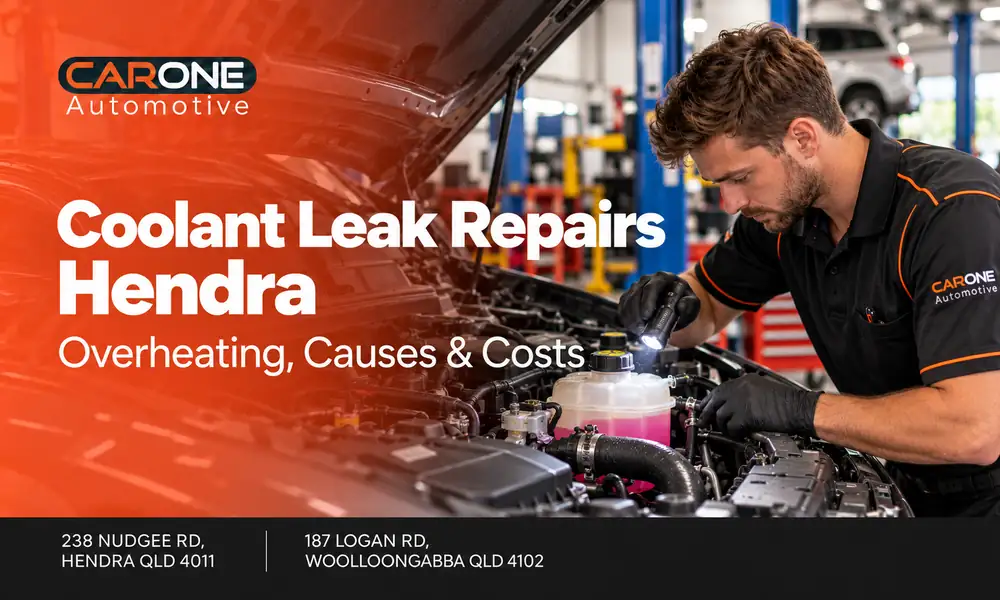
Airport-run idling and loaded Eagle Farm QLD 4009 utes put northside cooling systems under constant load. Under that kind of pressure, a small leak never stays small for long.
This guide covers the cost of coolant leak repair by cause for 2026 and exactly what to do the moment your temperature gauge starts to climb. It also shows where drivers near Hendra QLD 4011 can book a pressure test before a slow leak turns into a full overheat.
Here is what you will learn:
- Costs by cause (table)
- What causes leaks
- The overheating drill, step by step
- Where to book
What causes coolant leaks?
Aged hoses, corroded radiators, failing water pumps and cracked thermostat housings cause most coolant leaks, all accelerated by Queensland heat and heavy loads.
Rubber hoses harden and crack with age, and their clamps loosen as the engine heats and cools thousands of times. A radiator can corrode from the inside when old coolant loses its protective additives, while plastic end tanks crack under constant heat cycling. A water pump usually leaks from its seal first, often leaving a crusty trail below the pulley.
The signs are usually visible before the damage is done. Look for a sweet smell after driving, green, pink or orange drips under the car, white crust around hose joints, or a coolant level that keeps dropping between checks.
Some leaks are easy to spot with a torch, while others only appear when the system is hot and under pressure. Our guide on how to detect common coolant leak issues walks through the checks you can safely do at home, including where to look and which colours and smells point to which parts.
Using the wrong coolant causes trouble too. Mixing incompatible types can form sludge that blocks the radiator and attacks seals, so always top up with the type your manufacturer specifies.
At the Hendra workshop, loaded work utes are the vehicles we see with cooling problems most often. Towing, heavy payloads and long idling in the airport precinct keep engines hot for hours, which wears hoses and water pumps well ahead of schedule.
How much does coolant leak repair cost?
Coolant leak repair at Hendra runs $100 to $250 for hoses, $450 to $1,100 for radiators and water pumps, and $1,800 or more once a head gasket is involved, in 2026.
The cause decides the bill, which is why a pressure test comes before any quote. The technician pressurises the cooling system to its working pressure and watches for drops, drips and seepage. A combustion gas test can then confirm or rule out an internal leak.
The table below shows typical 2026 repair costs by cause, along with how urgently each one needs attention.
| Cause | Typical repair (2026) | Urgency |
| Hose or clamp | $100 to $250 | Days, not weeks |
| Radiator | $450 to $900 | Book now |
| Water pump | $500 to $1,100 | Book now |
| Head gasket | $1,800 to $3,500+ | Stop driving |
A proper quote should name the leaking part, the replacement coolant type and whether a thermostat or cap is included. Our page on coolant leak inspection and repair explains how the pressure test works, what the repair includes and how the workshop confirms the fix before the car goes home.
Cooling system work is a standard repair category for Queensland motorists, with clear benchmarks for what a fair job looks like. The RACQ guide to car service and repairs lists cooling system repairs among the everyday services drivers rely on, which gives you a sensible reference point when comparing workshop quotes.
The costs escalate quickly if a leak is ignored. A $150 hose left too long can overheat the engine, and that turns into a head gasket bill ten times larger.
What do you do when the temperature gauge climbs?
Pull over, switch off and never open the cap hot, then call for help rather than limping on, because ten more minutes of overheating can warp the cylinder head.
Follow these steps the moment the gauge heads toward hot or a red temperature light appears:
- Indicate and pull over somewhere safe as soon as you can.
- Switch the engine off to stop further heat building up.
- Open the bonnet from inside the car to let heat escape.
- Never open the radiator or reservoir cap while the engine is hot.
- Wait at least 30 minutes before checking the coolant level.
- Call for advice or a tow instead of driving on.
Once the car is safe, the next question is what the overheating has already done to the engine. Our article on how ignoring coolant leaks costs you big explains how a minor leak turns into major engine damage, and why acting early is always cheaper than waiting for a breakdown.
Overheating damages the engine in stages. A few minutes can warp the cylinder head, while longer running can blow the head gasket and mix coolant with oil.
The warning signs of a failed head gasket include white exhaust smoke with a sweet smell, milky oil and bubbling in the coolant reservoir. If you see any of these, stop driving and book a pressure and combustion test.
Where can northside drivers get a leak fixed?
Drivers in Hendra, Nundah, Eagle Farm and Albion can book a same-day pressure test minutes away, and southside drivers have the Woolloongabba option.
Most hose and clamp repairs are finished the same day, while radiators and water pumps may need parts ordered in. Drivers from Nundah QLD 4012 and Albion QLD 4010 can usually drop the car in the morning and receive a call with findings before lunch.
If the car is already overheating, do not drive it in. Arrange a tow instead, and the workshop can talk you through the safest option over the phone.
The table below shows typical off-peak drive times to the Hendra workshop from nearby northside suburbs.
| From suburb | Drive time (off-peak) | Route note |
| Eagle Farm QLD 4009 | ~4 minutes | Via Links Ave |
| Pinkenba QLD 4008 | ~8 minutes | Via Eagle Farm Rd |
| Albion QLD 4010 | ~7 minutes | Via Sandgate Rd |
| Nundah QLD 4012 | ~6 minutes | Via Sandgate Rd |
Checking directions, trading hours and recent reviews first helps you plan a pressure test neatly around the working day. You can find the Hendra workshop on Google for the route from Hendra, Nundah or Eagle Farm, along with current opening hours and feedback from other northside drivers and trade customers.
Drivers who live or work south of the river may find a southside workshop more convenient for cooling system work. Our guide to coolant leak repair on the southside covers the same causes, costs and overheating advice for southside drivers, with typical drive times from the suburbs surrounding the Gabba precinct.
The website also has a dedicated page with parking details, booking options and the full list of northside services on offer. Visit the Hendra workshop location to see the address and suburbs covered, so you can plan a cooling check that fits neatly around work or the school run.
So, how to fix coolant leak problems for good? The honest answer is professionally, because stop-leak bottles only delay the repair and can clog heater cores and radiator tubes along the way.
Conclusion
Coolant leaks compound over time, and the choice is usually hose money today or head gasket money next month. Aged hoses, corroded radiators and failing water pumps cause most leaks, and Queensland heat and heavy loads speed up every one of them.
A pressure test finds the real cause before any quote is written. Hose repairs typically cost $100 to $250, radiators and water pumps $450 to $1,100, and a head gasket $1,800 or more once overheating has done its damage.
If the gauge climbs, pull over, switch off and never open the cap hot. For same-day pressure testing and honest cooling system repairs on the northside, Car One Automotive handles it at Hendra, just minutes from Nundah, Eagle Farm and Albion.
Frequently Asked Questions
How much is coolant leak repair at Hendra?
Repairs range from $100 to $250 for hoses to $450 to $1,100 for radiators and water pumps in 2026. Head gasket repairs start from $1,800. A pressure test comes first, so the quote covers the real cause of the leak.
What do I do if my car overheats?
Pull over, switch the engine off and never open the cap while it is hot. Call for advice or a tow rather than limping on, because a few minutes of overheating can warp the cylinder head and cause major damage.
Why does my coolant keep dropping?
A dropping coolant level usually means an external or internal leak, or evaporation from a hidden hot leak point. A pressure test and combustion gas check identify which one it is, so the right repair is quoted the first time.
Are stop-leak products safe?
Stop-leak products are only suitable as a short-term measure to get you home or to a workshop. They can clog heater cores and radiator tubes, and the underlying fault remains, so the leak still needs a proper professional repair afterwards.
Do work utes need cooling checks more often?
Yes. Heavy loads, towing and long idle times put extra stress on a ute’s cooling system, especially in Queensland heat. A cooling system check at every service is cheap insurance against a breakdown and an expensive head gasket repair later.