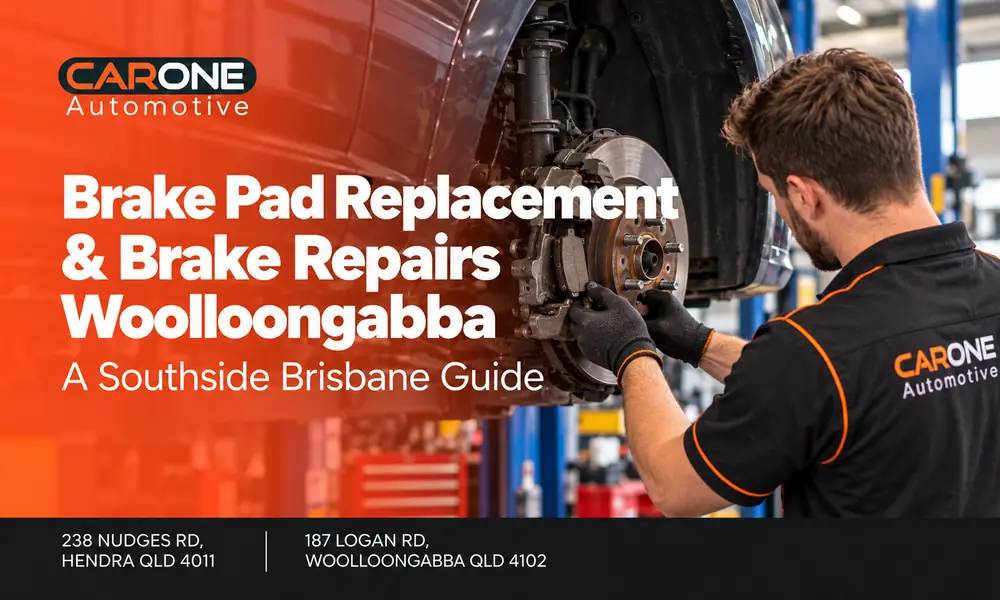
Brakes never fail all at once. They fade quietly until the day you need them most, usually in Stanley Street stop-start traffic when there’s no room to react.
This guide gives southside drivers the straight numbers on rear brake pads: fitted brake pad prices per axle in 2026, the warning signs decoded, when rotors need doing too, and where to book same-day near Woolloongabba.
Brakes are also one of the few repairs where waiting genuinely costs more than acting early. A pad job caught in time stays a pad job. Left too long, it becomes a rotor job, and left longer still, it can mean a caliper replacement on top of everything else.
Here is what you will learn:
- Fitted prices per axle, with table
- Warning signs decoded, with table
- Pads vs rotors, what actually needs replacing
- Where to book on the southside
How Much Does Brake Pad Replacement Cost in Woolloongabba?
Brake pad replacement in Woolloongabba costs $250-$450 per axle fitted in 2026, rising to $400-$900 per axle when rotors need machining or replacement.
| Job | Typical fitted price, 2026 | Time |
| Front pads, per axle | $250-$450 | 1-2 hours |
| Rear pads, per axle | $250-$450 | 1-2 hours |
| Pads plus machined rotors | $400-$700 per axle | 2-3 hours |
| Pads plus new rotors | $500-$900 per axle | 2-3 hours |
RACQ’s car service and repairs page lists brake inspections and repairs as a standard workshop category, a useful Queensland benchmark against the figures above. For an exact comparison against rear-specific pricing, rear brake pad costs in Brisbane covers that side of the job in more depth.
It’s worth asking whether the quoted price includes a brake fluid check as part of the job, since fluid that has absorbed moisture over time reduces braking performance in ways that new pads alone won’t fix.
Front pads typically wear faster than rears on most passenger cars, since the front axle carries the majority of braking load under normal driving. This is why a lot of cars go through two or three front pad replacements for every one rear replacement over their life, and it’s worth keeping in mind when a quote seems unusually high for a rear-only job.
What Are the Warning Signs Your Brakes Need Attention?
The clearest brake warning signs are squealing on light braking, grinding, longer stopping distances, pulling to one side, and a pulsing pedal.
| Sign | What it means |
| Squealing on light braking | Wear indicators touching, pads low |
| Grinding | Metal on metal, stop driving, rotors at risk |
| Longer stopping distance | Pads glazed or worn |
| Pulling to one side | Uneven wear or sticking caliper |
| Pulsing pedal | Warped rotors |
Grinding is the one sign worth treating as an immediate stop-driving warning rather than something to book in for later. Once metal is contacting metal, every kilometre driven adds cost to the rotor damage underneath, turning a straightforward pad job into a more expensive rotor replacement, and in worse cases can damage the caliper as well if ignored for long enough.
For a fuller rundown of what each sign means and how urgently to act, brake warning signs to act on breaks it down category by category. And for the servicing picture beyond brakes specifically, the complete Woolloongabba mechanic guide covers everything else a southside workshop handles.
The location itself matters too when brakes are involved, since a workshop close to home means less driving on brakes you’re already worried about. The Woolloongabba workshop location has directions and hours for anyone wanting to get a squealing brake checked without delay.
A pulsing pedal is one sign drivers often mistake for a soft or spongy brake feel, but the two point to different problems. A pulsing pedal usually means warped rotors, while a soft pedal more often points to air in the brake lines or worn fluid, which is why a proper inspection rather than guesswork matters here.
It’s also worth paying attention to any burning smell after a long descent or heavy braking, since this can indicate the brakes have been working harder than normal and are running hot, which accelerates wear on both pads and rotors if it happens repeatedly.
Pads or Rotors, What Actually Needs Replacing?
Pads wear on every drive and are the usual replacement, while rotors only need machining or replacing when worn below minimum thickness, warped, or scored by metal-on-metal contact.
This distinction matters for cost as much as safety. A pad-only job is the cheaper end of the range shown above, while rotors add real money because they involve more labour and pricier parts. CHOICE’s guide to car warranties and dealer servicing confirms that ACCC guidance protects your right to have brake work done at any qualified independent workshop without affecting your new-car warranty.
For the specific wear limits that determine whether pads alone will do, when to replace brake pads explains the measurements a technician checks before quoting.
There’s also a common misconception worth clearing up here, that all four wheels need the same brake work done at the same time. In practice, front and rear pads wear at different rates and are assessed and replaced independently. A workshop that insists on doing all four regardless of actual wear is padding the invoice rather than servicing to what the car actually needs.
Where Can You Get Brakes Done Near Woolloongabba?
Drivers in Woolloongabba, East Brisbane, Coorparoo and Annerley can get a brake inspection and same-day pad replacement at a certified southside workshop minutes away.
| From suburb | Drive time, off-peak | Route note |
| East Brisbane QLD 4169 | About 5 minutes | Via Stanley St |
| Annerley QLD 4103 | About 6 minutes | Via Ipswich Rd |
| Coorparoo QLD 4151 | About 7 minutes | Via Old Cleveland Rd |
| Brisbane City QLD 4000 | About 8 minutes | Via Captain Cook Bridge |
Before booking, it’s worth checking recent reviews from local drivers. The Woolloongabba workshop on Google lists feedback from customers across Woolloongabba, East Brisbane and Coorparoo who’ve had brake work done there.
For anyone comparing costs against a wider Brisbane benchmark, a rear brake pad replacement cost brisbane search should land close to the ranges shown above, with the biggest variable being whether rotors need attention alongside the pads themselves.
If you drive across a few different suburbs regularly, whether commuting into the city or dropping kids at different schools, having a single trusted brake workshop rather than the nearest one each time means a consistent record of exactly when pads and rotors were last checked, which is worth more than the marginal convenience of the closest option on any given day.
Conclusion
Brakes are the one repair you never gamble on, and caught early, pads are cheap compared with rotors and calipers. For same-day brake work on the southside, Car One Automotive handles it in Woolloongabba.
FAQ
How Much Are Brake Pads Fitted Per Axle?
Typically $250-$450 per axle in 2026 for a straightforward pad-only job. Adding machined rotors brings the price to $400-$700, and fitting entirely new rotors takes the total to around $500-$900 per axle overall for most vehicles.
Can Brake Pads Be Replaced Same-Day?
Yes, pads for common vehicle makes are usually in stock or available same-day, and the job itself typically takes 1-2 hours per axle once the car is booked in at a certified southside workshop nearby.
What Does Grinding When Braking Mean?
Grinding means metal-on-metal contact, which tells you the pads are already gone and the rotors underneath are actively being damaged. Stop driving as soon as it’s safe and book an inspection immediately rather than delaying it further.
Do I Always Need New Rotors With New Pads?
No. Rotors are only machined or replaced when they measure below minimum thickness, are warped, or have been scored by metal contact. A workshop measures them properly before quoting, rather than replacing them automatically every single time.
How Long Do Brake Pads Last?
Typically 40,000-70,000 km, but city stop-start driving common across the southside wears pads faster than steady highway driving would, so it’s worth checking them at every routine service rather than waiting for an obvious warning sign.