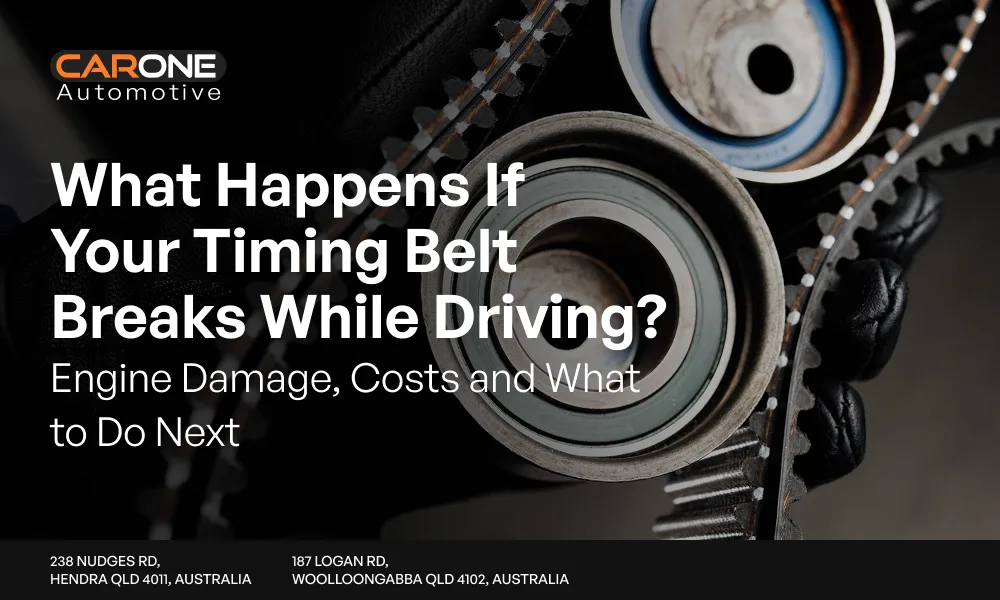
A snapped timing belt is one of the most stressful breakdowns, because the engine stops suddenly and the damage is hidden inside.
This guide explains what has happened when a timing belt broke, what not to do, and how a mechanic works out whether the engine can be saved.
In this guide, you will learn:
- What happens inside the engine when the belt snaps
- Why interference engines suffer the worst damage
- What to do at the roadside
- Typical repair paths and costs
- How to stop it happening again
What Happens If a Timing Belt Breaks While Driving?
The engine stops immediately, and in an interference engine the valves can hit the pistons, bending valves and sometimes damaging pistons or the cylinder head.
Exactly what happens if timing belt breaks while driving depends on the engine, but most drivers notice a sudden loss of power, and the engine will not restart. Some also hear a clatter from the engine as the valves and pistons make contact.
Once the engine stops, the steering and brakes become heavy because the power assistance goes with it. Pull over safely and brake early, and keep in mind that the extent of the damage cannot be confirmed without an inspection.
The next step is getting the engine checked properly rather than guessing at the damage, because the right repair depends entirely on what a test finds inside the engine. You can book timing belt replacement in Brisbane once the car has been towed, and the workshop will test the engine before any parts are ordered. That way the repair decision is based on what the test actually shows.
Which Engines Are Damaged When the Timing Belt Snaps?
Interference engines, where valves and pistons share the same space at different times, usually suffer valve damage when the belt snaps, while non-interference engines often survive with only a new belt needed.
An interference engine timing belt failure is the expensive kind, because the pistons can strike the open valves and cause piston damage as well. In a non-interference design the parts never occupy the same space, so the engine usually stops without harm.
Most modern petrol and diesel engines are interference designs, so assume damage is possible until a test says otherwise.
Not every engine has a belt in the first place, and a chain behaves differently when it fails. Our guide to timing belt vs timing chain explains how to find out whether your engine has a belt or chain and what each one means for repairs. It is worth checking before you assume a belt is the problem.
What Should You Do Straight After a Timing Belt Breaks?
Pull over safely, switch off the ignition and do not try to restart the engine, because cranking can cause further valve and piston damage; arrange a tow to a workshop.
Follow this short roadside checklist:
- Switch on the hazard lights and pull over as safely as you can.
- Switch off the ignition and take the key out.
- Do not crank the engine to see whether it will start.
- Call roadside assistance or a tow operator.
- Arrange a tow to a workshop that can test the engine.
If the valves are already bent, each turn of the starter can push the pistons into them again and add piston damage.
Not every no-start is a snapped belt, so it helps to know the other possibilities before you assume the worst. Our guide to the common reasons a car won’t start explains the other no-start causes, such as a flat battery or a fuel problem. A tow to a workshop is still the safe choice either way, so the cause can be confirmed with a test.
How Much Does It Cost to Fix an Engine After the Timing Belt Breaks?
Repairs after a snapped belt range from about 1,000-1,500 for a non-interference engine needing only a belt kit, to 3,000-7,000 or more when valves, head work or engine replacement are required.
The table below shows typical Brisbane repair costs and times after a timing belt snaps.
| Damage Found | Typical Repair | Typical Cost (AUD) | Typical Time |
| None (non-interference engine) | New belt kit and water pump | 1,000-1,500 | 1 day |
| A few bent valves | Cylinder head off, valves replaced, head machined | 3,000-4,500 | 4-7 days |
| Bent valves and damaged pistons | Major engine rebuild | 4,500-7,000+ | 1-3 weeks |
| Severe damage on a low-value car | Replacement used engine | 3,500-7,000+ | 1-2 weeks |
The workshop works out which row applies with a compression or leak-down test, and sometimes a borescope inspection through the spark plug holes. These tests show whether the valves and pistons are sealing, which is the fastest way to separate a belt-only repair from a head job. A proper plan starts with car diagnostics rather than a guess, because the result decides which repair is worth doing and what the quote should include for your engine.
One towed-in car showed low compression on a single cylinder, which pointed to bent valves. The owner chose a cylinder head repair over a replacement engine after seeing a written quote.
Diagnostic testing is a standard repair category at Queensland workshops, which is why a damage test before any parts are ordered is normal practice, as listed on RACQ’s car service and repairs page, and it is worth asking for the test result and the quote in writing before you approve any of the work.
The timing belt broken engine damage cost depends entirely on what the test finds, and the cylinder head repair path sits in the middle of the range. Comparing the failure price with a planned job shows why prevention is cheaper, and our guide to timing belt replacement cost sets out what the scheduled job costs in Brisbane. The gap between the two figures is the strongest argument for replacing the belt on time.
Are Brisbane Drivers at Higher Risk of Timing Belt Failure?
Hot weather, heavy stop-start traffic and overdue services on older cars all raise the risk of belt failure, so local drivers should not stretch the replacement interval.
Summer heat hardens rubber, and congestion on the M1 and Gateway means long stretches of stop-start driving. Towing to the coast adds load, and older cars with no belt record are the most exposed.
If the car does break down, the tow is usually short. The workshops are 4 to 12 minutes off-peak from the suburbs in the table below, which keeps the tow distance and cost down.
Prevention starts with knowing the interval for your engine and sticking to it, especially in Brisbane’s heat and traffic. Our guide on when to replace a timing belt explains the kilometre and age limits and why Brisbane conditions can bring the date forward.
Where Should a Car With a Broken Timing Belt Be Towed in Brisbane?
A car with a broken timing belt should be towed, not driven, to a workshop that can test for valve damage, such as an independent mechanic in Woolloongabba on the southside or Hendra on the northside.
A tow to the nearest capable workshop keeps the cost down and gets the testing started quickly. For southside drivers, our southside workshop in Woolloongabba QLD 4102 takes tow-in timing belt failures from Annerley QLD 4103 and the surrounding suburbs, and tests the engine before any repair is quoted.
Northside owners do not need to cross the river, because the second workshop handles the same failures. Drivers in Hendra QLD 4011, Nundah QLD 4012 and Eagle Farm QLD 4009 can have the car towed to our northside workshop for the same testing. On arrival the first step is a compression test before any parts are ordered, so ask how long the test will take for your engine.
The table below shows off-peak drive times from nearby suburbs, and peak-hour traffic on the Pacific Motorway, Ipswich Rd and Kingsford Smith Dr can double them.
| Suburb | Nearest Workshop | Drive Time (Off-Peak) |
| East Brisbane | Woolloongabba | 5-8 min |
| Annerley | Woolloongabba | 8-12 min |
| Clayfield | Hendra | 5-8 min |
| Nundah | Hendra | 7-10 min |
| Ascot | Hendra | 4-7 min |
Choosing where to send a broken-down car is easier when you can see what other customers say about the workshop. Drivers from East Brisbane and Coorparoo can find the Woolloongabba workshop on Google Maps, where directions, photos and customer reviews sit together.
The same check is available on the northside before you book a tow. Northside drivers in Ascot and Clayfield can read reviews of our Hendra workshop on Google Maps, alongside directions and photos of the site.
How Do You Prevent a Timing Belt Broke Situation Happening Again?
Replacing the belt, tensioner, idlers and water pump on schedule, and fixing any oil or coolant leak near the belt, prevents most timing belt failures.
What does a timing belt do? It keeps the crankshaft and camshafts turning in exact time, and because it is rubber, it hardens and wears with age. If a timing belt broke on your last car, the lesson is to replace it on schedule, and a non-interference engine is no reason to relax.
Leaks are a common cause of early failure, because oil and coolant soften the rubber. A weeping pump is the usual source, and our guide to water pump failure symptoms explains how to spot a failing pump before it reaches the belt. Fixing the leak at the same visit protects the new belt.
Keep every receipt so the next owner knows the belt history. Have the new belt recorded in the logbook as well, because logbook stamps from an independent workshop are valid when the work is done by qualified staff using fit-for-purpose parts, as the AAAA guide to new car servicing explains in plain language for owners. A complete record also helps resale value and gives the next owner confidence that the belt was changed on time.
Conclusion
A snapped timing belt stops the engine instantly and may damage valves and pistons. Stop driving, avoid cranking and arrange a tow so the damage can be tested properly. Car One Automotive can inspect and repair timing belt failures at its Woolloongabba and Hendra workshops.
Frequently Asked Questions
Can a Car Be Driven After a New Timing Belt Is Fitted to a Damaged Engine?
Only if testing shows the valves and pistons are undamaged. Fitting a new belt to an engine with bent valves leaves it with low compression, misfires and a high risk of further failure, so test the engine before anything else.
Does Car Insurance Cover Engine Damage From a Snapped Timing Belt?
Usually not. Most comprehensive policies treat a snapped belt as mechanical wear rather than an accident, so check the policy wording or ask the insurer before authorising any repairs, and keep the tow and test paperwork handy for any claim.
What Noise Does a Timing Belt Make Just Before It Snaps?
Some belts give a ticking, slapping or whining noise from the front of the engine when a tensioner or pulley is failing. Many belts snap with no warning at all, so the replacement interval matters far more than any noise.
Is It Worth Repairing an Older Car After the Timing Belt Breaks?
It depends on the damage test and the car’s value. A belt-only repair is usually worth it, while a 4,500-7,000 rebuild may not suit a low-value car, so ask for a written quote and compare all the repair options first.
Can a Timing Belt Jump Teeth Without Fully Breaking?
Yes. A loose or worn belt can skip teeth, which throws the valve timing out, causes rough running and a warning light, and can still cause valve damage in an interference engine if the car keeps being driven hard afterwards.