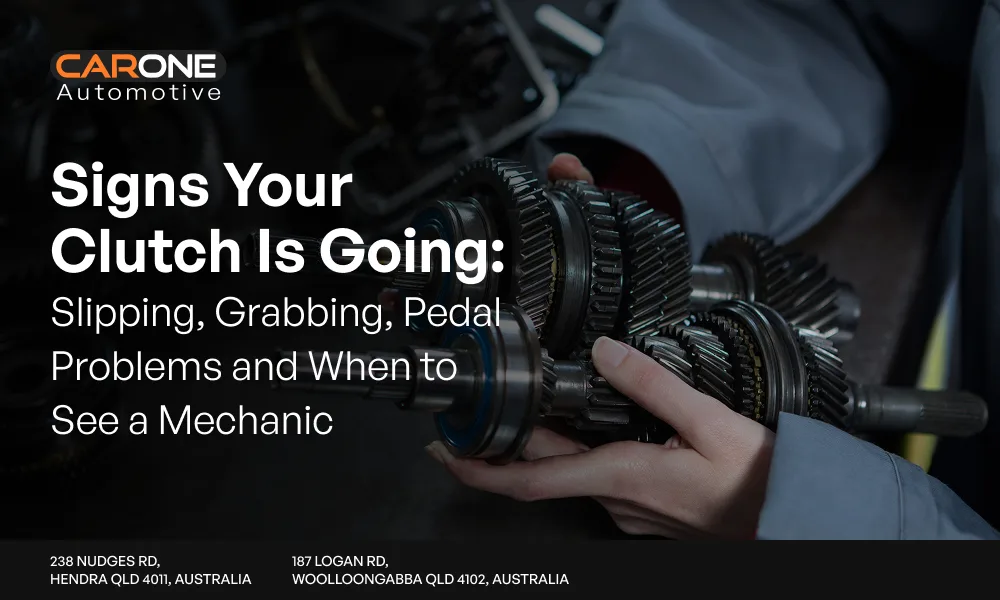
Clutches wear out gradually, so the early signs are easy to miss in a manual car until it struggles on a hill.
This guide explains the main signs of clutch going bad, what each one usually means and how quickly to act.
In this guide, you will learn:
- The clearest sign of a slipping clutch
- What a high biting point or soft pedal means
- Burning smells and noises to take seriously
- How long clutches usually last
- When to book an inspection
What Are the Signs Your Clutch Is Going?
Revs rising without the car speeding up, a high biting point, a burning smell, juddering when moving off and difficulty selecting gears are the most common signs a clutch is wearing out.
These are the signs to watch for, each with what it usually means:
- Slipping: the engine speeds up but the car does not, because the friction plate cannot grip.
- High biting point: the clutch only grips near the top of the pedal, which points to wear.
- Burning smell: the clutch is overheating from slipping.
- Judder: the car shudders when moving off, often from uneven wear or contamination.
- Hard gear selection: the clutch is not fully releasing.
For a simple check, accelerate in a higher gear at moderate speed on a safe, clear road. If the revs rise without speed, the clutch is slipping, and slipping clutch symptoms rarely improve on their own.
The table below shows each sign, its likely cause and how urgent it is.
| Sign | Likely Cause | Urgency |
| Revs rise but speed does not | Worn friction plate slipping | Book within days |
| High biting point | Worn friction plate | Book within weeks |
| Soft, spongy or sinking pedal | Leaking master or slave cylinder | Book within days |
| Burning smell after normal driving | Clutch slipping and overheating | Book within days |
| Whirring that changes when the pedal is pressed | Worn release bearing | Book within weeks |
Some of these signs overlap with gearbox or engine mount faults, so a road test is the only reliable way to separate them. Treat the table as a guide to urgency rather than a diagnosis.
Once you recognise the signs, the next step is a proper check rather than waiting for the clutch to fail. You can ask about clutch repairs in Brisbane and describe what you have noticed, so the workshop knows what to test. That helps confirm whether the clutch, the hydraulics or something else is responsible.
What Does a High Biting Point or Soft Pedal Mean?
A high biting point usually means the friction plate is worn, while a soft, spongy or sinking pedal more often points to a hydraulic fault such as a leaking master or slave cylinder.
A clutch biting point high up the pedal travel means the plate has worn thin and only grips when the pedal is almost released. A spongy clutch pedal is different, because it points to the hydraulic system rather than the friction plate.
One car was booked in for a new clutch because the pedal felt soft. The real fault was a leaking slave cylinder, which cost far less to fix than a clutch.
That is why the symptom matters more than the guess. A hydraulic clutch can also sink to the floor and stay there, and fixing the leak early protects the clutch from damage caused by a pedal that does not fully release.
Why Does a Clutch Smell Like Burning?
A burning smell like hot paper or brakes usually means the clutch has been slipping and overheating, often from hill starts, towing or riding the pedal, and repeated smells point to a worn plate.
A clutch burning smell after one steep hill start does not necessarily mean the clutch has failed. If the smell returns after ordinary driving, the plate is probably worn and slipping.
Noise is the other warning. A release bearing noise shows up as a whirring or chirping that changes when the pedal is pressed, and it is worth having checked before it damages the clutch.
How Long Does a Clutch Last in Brisbane Driving?
Clutches commonly last 100,000-150,000 km, but heavy stop-start traffic, hilly suburbs, towing and riding the pedal can shorten that significantly.
Peak-hour queues on the M1 and Gateway, hilly inner suburbs and towing to the coast all add heat and slip. A clutch judder that appears on hills is often the first sign that wear is catching up.
Three habits extend clutch life. Do not rest your foot on the pedal, use the handbrake on hills rather than holding the car on the clutch, and select neutral at long stops.
If the signs are already there, planning for the bill is sensible. Our guide to clutch replacement cost shows typical Brisbane prices by vehicle type and explains what pushes the total up. Knowing the range before the inspection helps you judge the quote.
Could the Problem Be the Gearbox Instead of the Clutch?
Grinding on one gear, whining that changes with road speed or jumping out of gear usually points to the gearbox rather than the clutch, and needs a different repair.
Here is a short comparison of the two:
- Clutch symptoms: slipping, a high biting point, judder and a burning smell.
- Gearbox symptoms: grinding when changing gear on one gear only, whining that changes with road speed and jumping out of gear.
Only a road test and inspection can confirm the cause, because some symptoms overlap. Grinding when changing gear on every gear can still be a clutch that is not releasing.
Gear problems are often fixed more simply than owners expect. Our guide to transmission and clutch repairs explains how common gear faults are diagnosed and repaired, from hydraulic fixes to a full clutch. Read it before you decide what to ask the workshop for.
Not every car has a clutch pedal, and automatic dual-clutch gearboxes show different symptoms. If yours is one of them, our guide to the dual-clutch transmission explains how it works and why a judder there means something different. The advice in this guide applies mainly to manual cars.
Where Can You Get a Clutch Inspected in Brisbane?
Clutch inspections, including a road test and hydraulic check, are offered by independent workshops on both sides of Brisbane, such as Woolloongabba on the southside and Hendra on the northside.
For southside drivers, our southside workshop in Woolloongabba QLD 4102 handles clutch road tests and inspections for Coorparoo QLD 4151 and East Brisbane QLD 4169, and explains the findings before any work is quoted.
Northside owners can have the same inspection without travelling south, because the second workshop does the same work. Drivers in Hendra QLD 4011, Ascot QLD 4007 and Clayfield can book with our northside workshop and describe the symptoms. A clutch inspection starts with a road test for slipping, the biting point and judder, then a hydraulic check separates clutch wear from a leaking cylinder.
The table below shows off-peak drive times from nearby suburbs, and peak-hour traffic on the Pacific Motorway, Ipswich Rd and Kingsford Smith Dr can double them.
| Suburb | Nearest Workshop | Drive Time (Off-Peak) |
| Coorparoo | Woolloongabba | 6-10 min |
| East Brisbane | Woolloongabba | 5-8 min |
| Annerley | Woolloongabba | 8-12 min |
| Ascot | Hendra | 4-7 min |
| Clayfield | Hendra | 5-8 min |
| Nundah | Hendra | 7-10 min |
Reading what other drivers say takes a minute and shows how a workshop explains clutch findings. Drivers from East Brisbane and Coorparoo can find the Woolloongabba workshop on Google Maps, with directions, photos and reviews from other customers in one place. Read a few recent ones before you book.
The same check is available on the northside. Northside drivers in Ascot and Clayfield can read reviews of our Hendra workshop on Google Maps, alongside directions and photos of the site. Look for comments about clear explanations.
How Urgent Are the Signs of Clutch Going?
A slipping clutch will get worse and can leave the car unable to climb hills or move at all, so book an inspection within days rather than weeks once slipping starts.
Rank the signs by urgency. Slipping, a sinking pedal and a burning smell need attention within days, while a high biting point or a whirring release bearing can wait a few weeks. A hydraulic clutch fault that leaves the pedal on the floor should not be driven.
Do not tow with a slipping clutch, because the extra load will finish it quickly. If the signs match, it is worth booking a Brisbane mechanic within days so the plate does not fail on the road. A short inspection now is far cheaper than a tow later.
Several symptoms at once usually mean the problem is further along. Our guide to the signs your car needs a mechanic now lists the urgent warning signs that should not wait for the next service. Use it if the clutch is not the only thing that feels wrong.
A clutch that fails unusually early on a newer car may be covered. Consumer guarantees apply automatically, and a manufacturer’s warranty cannot take those rights away, according to the ACCC warranties page. Contact the manufacturer before paying for repairs, and keep the service records.
Conclusion
Slipping, a high biting point and burning smells are the clearest signs your clutch is wearing out. An inspection confirms whether it is the clutch, the hydraulics or the gearbox. Book a clutch check with Car One Automotive at Woolloongabba or Hendra.
Frequently Asked Questions
Can a Slipping Clutch Fix Itself?
No. A slipping clutch usually indicates worn or contaminated friction material, and the problem typically worsens over time. An early inspection may identify an oil leak or hydraulic fault before further damage occurs, potentially reducing repair costs.
Is It Bad to Rest Your Foot on the Clutch Pedal?
Yes. Resting your foot on the clutch pedal can cause partial engagement, increasing wear on the release bearing and clutch components. Keep your foot on the floor or footrest between gear changes to help extend the clutch’s lifespan.
Why Is My Clutch Pedal Sticking to the Floor?
A clutch pedal that stays down may indicate a hydraulic problem, such as a leaking master or slave cylinder or air in the system. Avoid driving the vehicle until a mechanic identifies the fault and confirms it is safe.
Does a Heavy Clutch Pedal Mean the Clutch Is Failing?
Not necessarily. A heavier clutch pedal can indicate a worn pressure plate, a binding cable or a hydraulic fault. Have a mechanic inspect the system to identify the cause before deciding whether the clutch assembly needs replacement.
Can I Still Drive to the Workshop With a Slipping Clutch?
Driving a short distance may be possible if the clutch still operates reliably, but it carries risks. Avoid hills, heavy loads and towing. If the engine revs rise without acceleration or the vehicle struggles to move, arrange towing instead.